
|
Walter Pitts
born April 1923, Detroit · died 1969, Cambridge, Massachusetts · logician
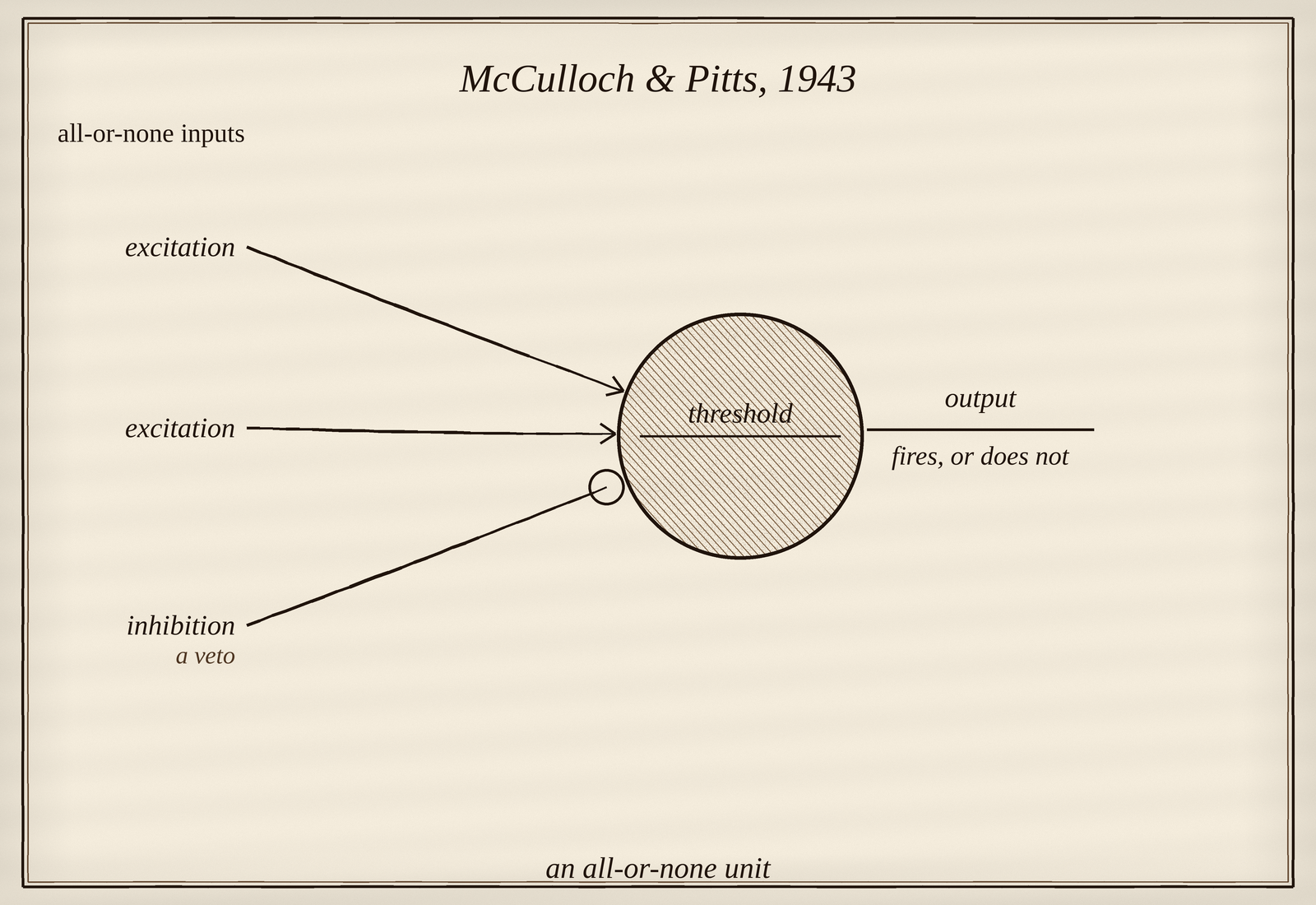
Chicago He arrived in Chicago as a penniless teenager: Lettvin puts it in 1937, aged fourteen; Gefter says fifteen. He haunted the University of Chicago without enrolling. Lettvin tells of him walking into Rudolf Carnap's office with an annotated copy of Carnap's own book. The more famous story, that as a boy he wrote to Bertrand Russell about errors in Principia Mathematica, is best treated as legend (Wilson, 2009). He and Lettvin were friends from 1938; Lettvin's account also places Hy Minsky in their circle. In 1941 Gerhardt von Bonin introduced the two young men to Warren McCulloch, then at the University of Illinois in Chicago. McCulloch and his wife Rook took them into their house (Lettvin, J. Y., 1999)(Gefter, A., 2015). the paper "A logical calculus of the ideas immanent in nervous activity" (McCulloch & Pitts, 1943) treated each neuron as an all-or-none unit with a threshold, fired by excitation and vetoed by inhibition, and showed that nets of such units could compute any expression of propositional logic; with loops, they could hold a state, which is to say remember. The physiology was a deliberate simplification, and both authors knew it. The logic was Pitts's. John von Neumann's 1945 draft report on the EDVAC, the plan for the stored-program computer, cites this paper and no other (Piccinini, 2004)(Gefter, A., 2015). Stephen Kleene later reworked its loops into the theory of regular events and finite automata (Kleene, 1956).
MIT In 1943, visiting Lettvin in Boston, Pitts met Norbert Wiener, who took him on as a student; in 1944 he worked for Kellex, the contractor building the gaseous diffusion plant for the atomic bomb (Lettvin, J. Y., 1999). At Wiener's behest, Jerome Wiesner of MIT's Research Laboratory of Electronics invited McCulloch, Pat Wall and Lettvin to join him there: 1951 in Lettvin's account, 1952 in Gefter's. For a short time the group around Wiener and McCulloch looked like the centre of a new science. Fortune magazine, in June 1954, listed Pitts among the most promising young scientists in America (among ten, says Smalheiser; among twenty, says Gefter). the break Then Wiener cut them off. A message from Mexico City, where the Wieners were visiting Arturo Rosenblueth, ended all contact; Lettvin calls it a "viciously phrased" letter to Wiesner, late in 1952. The reason, as Rosenblueth told Lettvin only a decade later, was that Margaret Wiener had told her husband that men in McCulloch's group had seduced their daughter Barbara. The full story, the conflicting accounts and what is and is not known are on a page of their own: the break. He destroyed all of his past work that he could find and became a ghost long before he died. Smalheiser dates the burning of his thesis to about the time of the break, "arguably because of it"; other accounts put it later. In 1955 he would not sign the papers that would have given him a doctorate (Smalheiser, 2000). the frog He kept working, with Lettvin, Humberto Maturana and McCulloch, on the frog. "What the frog's eye tells the frog's brain" (Lettvin et al., 1959) found that the retina does not send the brain a picture but a few already-interpreted reports, one class of fibre responding best to a small dark object moving against the background: something like a bug. As Gefter quotes the paper: The eye speaks to the brain in a language already highly organized and interpreted The finding cut against the 1943 picture of the brain as a logic machine reading raw input; friends thought the result troubled him. See the archive page on the frog paper. A last paper, on the frog's sense of smell (Gesteland, Lettvin & Pitts, 1965), carries his name. the end He died on 14 May 1969, of bleeding from oesophageal varices, a complication of long drinking; Lettvin's phrase is that he "died alone in a boarding house in Cambridge". McCulloch died in September of the same year. Margaret Wiener lived until 1989. what is argued about How much of the 1943 paper was Pitts's; whether the paper was neuroscience at all or logic dressed in it (Piccinini, 2004)(Aizawa, 2012); and how far the collapse of his career can be laid at one letter. The sources here are friends' recollections, set down decades later; we treat their details as testimony, not record. why he is here Every artificial neural network descends from the 1943 unit. Pitts is also the clearest case in this collection of how much of a science can depend on one person's standing with another. in the tour: the room called "The kitchen at Hinsdale" has a placard called "1943" ··· Primary works and sources
see also
|
 alter Pitts was born in Detroit in April 1923 and left home young. He never took a degree. By the time he was twenty he had written, with Warren McCulloch, the paper that first treated neurons as logical devices; by the time he was thirty he had stopped publishing; he died at forty-six. What is known of his life comes mostly from friends, above all


 |
 |
 |
 |
 |
rev. Oct 24 2026