
|
Warren McCulloch
1898–1969 · neurophysiologist, Yale, Illinois, MIT
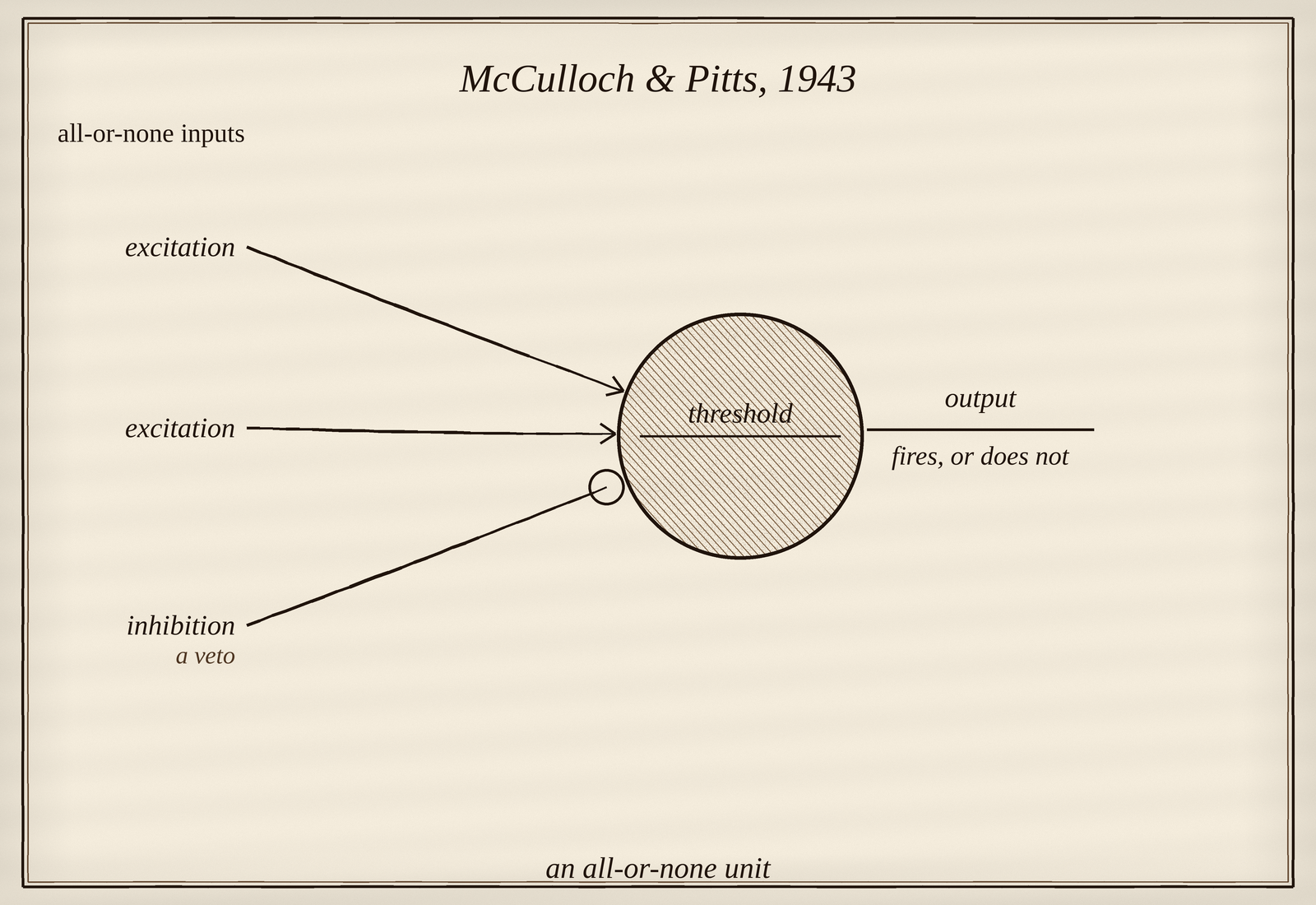
what he did With the young logician Walter Pitts he wrote "A logical calculus of the ideas immanent in nervous activity" (McCulloch & Pitts, 1943), which treated neurons as all-or-none threshold units and showed that networks of them could compute logical functions; with memory added, they claimed, such nets could compute what a Turing machine can [paraphrase, not a quotation]. Piccinini (2004) argues it was the first computational theory of mind and brain. Later, with Lettvin, Maturana and Pitts, he showed that a frog's retina sends the brain already-processed signals, such as for small moving dark objects (Lettvin et al., 1959).
what is argued about The 1943 neuron was an idealisation that real neurons do not obey, and the paper's notation was famously hard to follow. Abraham (2002) traces its origins in mathematical logic, philosophy and the physiology of the time; von Neumann's 1945 report on computer design borrowed its neurons as idealised switches. Whether it was neuroscience, logic or a manifesto is still discussed. why he is here Every artificial neural network descends, through the perceptron, from the McCulloch–Pitts unit. in the tour: the room called "Governors and feedback" has a placard called "McCulloch and Pitts, 1943" ··· Primary works and sources
see also
|
 arren Sturgis McCulloch trained in philosophy, psychology and medicine, and worked as a neurophysiologist at Yale, the University of Illinois in Chicago and, from 1952, MIT's Research Laboratory of Electronics. He chaired the Macy conferences on cybernetics (


 |
 |
 |
 |
 |
rev. Oct 24 2026