
|
Archive: What the frog's eye tells the frog's brain, 1959
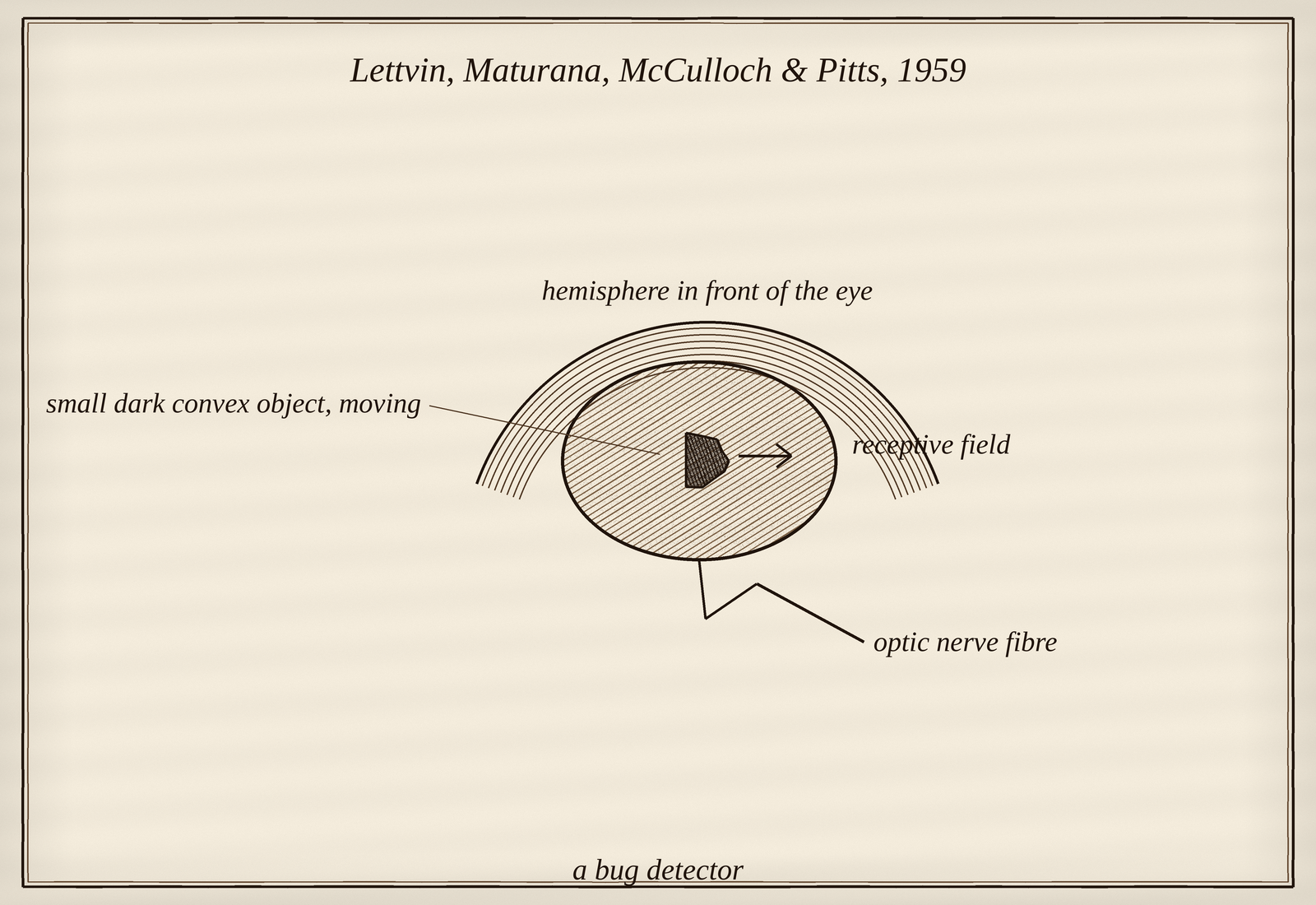
what it is, and where to read it A paper in Proceedings of the IRE (volume 47, pages 1940–1951), an engineering journal, written for engineers. The anatomy and fuller physiology followed in Maturana and colleagues (1960). The paper is on the publisher's page; it is under copyright, so we summarise it. what it says Recording from the endings of single optic nerve fibres in the frog's brain while moving objects across a hemisphere in front of the eye, the authors found four kinds of fibre. One reported sustained edges, one small dark convex objects moving in the field, the "bug detectors", one moving edges, and one dimming. Each kind ended in its own layer of the tectum. The eye, they concluded, does not transmit points of light; it reports, in a few categories, things that matter to a frog.
what's contested Priority and framing. Barlow (1953) had already found frog retinal cells that responded best to small moving spots and suggested they might be fly detectors. The phrase "feature detector" that grew from both papers has been criticised as too neat: later work found responses that vary with context and state. methodological critiques The stimuli were hand-moved objects and the classes were judged by eye; there were no quantitative tuning curves. Frogs were immobilised, which removes the eye movements and behaviour that shape vision in life. later reception The paper became one of the most cited in vision science and pushed the field toward asking what neurons signal rather than what they relay. For the 1943 picture of the brain as logic on raw inputs it was a blow, and it was Pitts's last major paper. See the break. in the tour: the room called "The frog's eye" has a placard called "Already interpreted" ··· References
see also
|
 hat does an eye send to a brain? In 1959


 |
 |
 |
 |
 |
rev. Oct 24 2026