Wilder Penfield
1891–1976 · neurosurgeon, Montreal
 ilder Graves Penfield was born in Spokane, trained at Princeton, Oxford (under Sherrington) and Johns Hopkins, and in 1934 founded the Montreal Neurological Institute.
what he did
Operating on patients with epilepsy under local anaesthetic, he stimulated the exposed cortex with a weak current to find the tissue he must spare, and asked the patient what happened. Movements, tingling and flashes were mapped in thousands of operations (Penfield & Boldrey, 1937)(Penfield, W. & Rasmussen, T., 1950), and summarised as the homunculus: see the little man. A few patients reported something stranger: a song, a voice, a scene, as if remembered (Penfield & Perot, 1963).
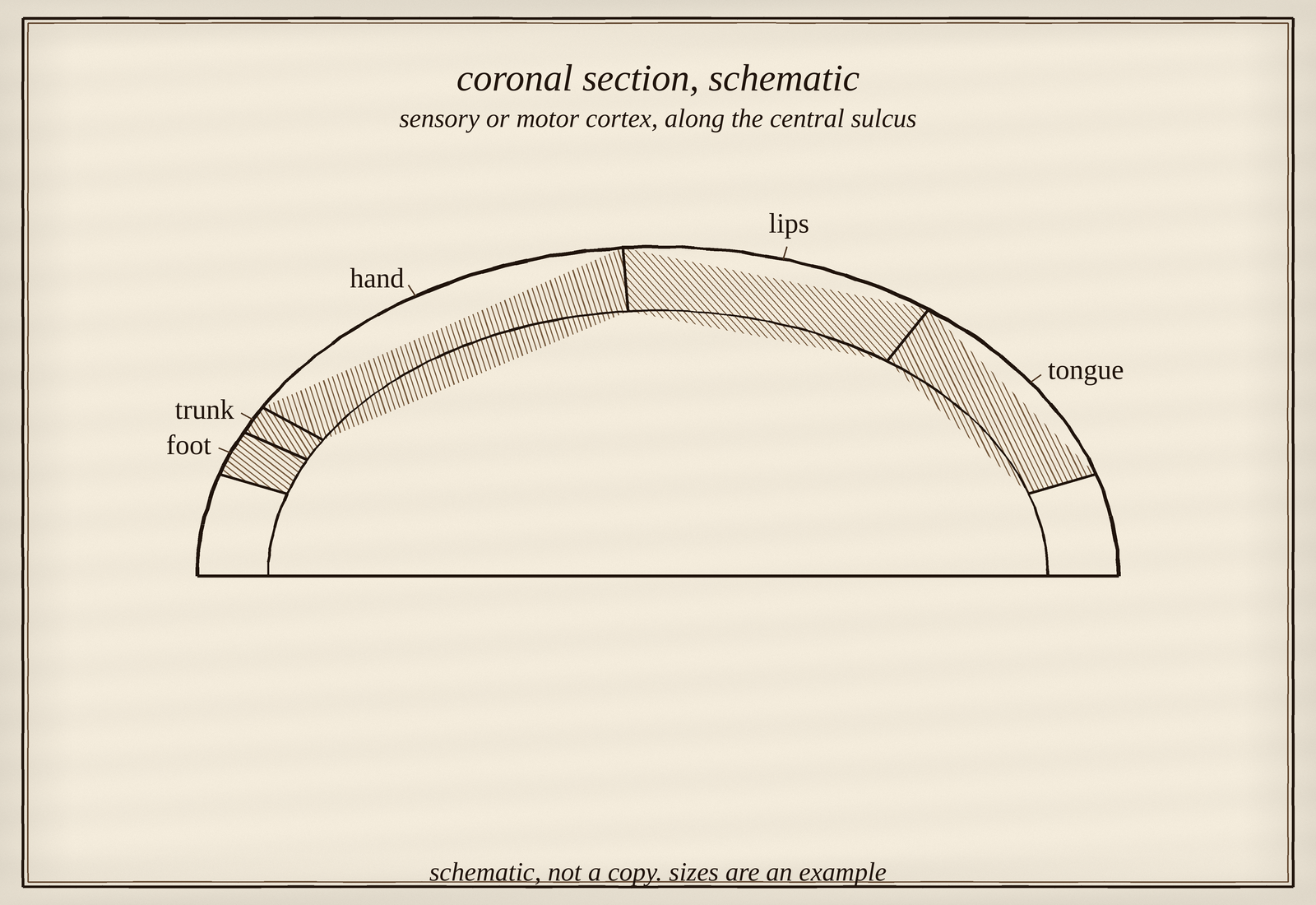
Schematic strip of sensory or motor cortex along the central sulcus, blocks for foot, trunk, hand, lips and tongue
Not a copy of Penfield's figures. Blocks, in order: foot, trunk, hand, lips, tongue. Foot, hand and mouth are the zones Gordon and colleagues (2023) name; hands, lips and tongue large, trunk and foot small. Sizes are an example. Drawn by script. credits |
what is argued about
Penfield came to think these experiential responses were replays of stored records. Loftus and Loftus read the same cases as reconstructions: rare, often dreamlike and unverifiable [paraphrase, not a quotation]. The maps themselves are averages over variable patients, and the drawing has been redrawn many times since (Schott, 1993)(Catani, 2017).
why he is here
His patients were the first to tell a scientist, in words, what stimulating one spot of the brain felt like. That is still the rarest kind of evidence in the field.
in the tour: the room called "The map" has a placard called "The little man" ···
Primary works and sources
- Penfield & Boldrey (1937). Somatic motor and sensory representation in the cerebral cortex of man as studied by electrical stimulation. Brain. doi:10.1093/brain/60.4.389
- Penfield, W. & Rasmussen, T. (1950). The Cerebral Cortex of Man: A Clinical Study of Localization of Function. New York: Macmillan.
- Penfield & Perot (1963). The brain’s record of auditory and visual experience: a final summary and discussion. Brain. doi:10.1093/brain/86.4.595
- Loftus & Loftus (1980). On the permanence of stored information in the human brain. American Psychologist. doi:10.1037/0003-066x.35.5.409
- Schott (1993). Penfield's homunculus: a note on cerebral cartography. Journal of Neurology, Neurosurgery & Psychiatry. doi:10.1136/jnnp.56.4.329
- Catani (2017). A little man of some importance. Brain. doi:10.1093/brain/awx270
see also
<< all people | glossary