
|
Phineas Gage
what Harlow wrote Harlow's account of the change is the passage everyone quotes, and it is worth reading whole rather than in summary: The equilibrium or balance, so to speak, between his intellectual faculties and animal propensities, seems to have been destroyed. He is fitful, irreverent, indulging at times in the grossest profanity (which was not previously his custom), manifesting but little deference for his fellows his mind was radically changed, so decidedly that his friends and acquaintances said he was "no longer Gage." The same paper records what is quoted less often. Gage went to Chile, where for nearly eight years he looked after horses and drove a coach, often six-in-hand, around Valparaiso and Santiago. His health failed; he joined his mother in San Francisco, and died there of epileptic convulsions. Harlow gives 21 May 1861; later archival work fixed the year as 1860 (Macmillan, M., 2000). Harlow had the skull and the iron brought east and deposited at Harvard, where they still are. He ended: I dressed him, God healed him.
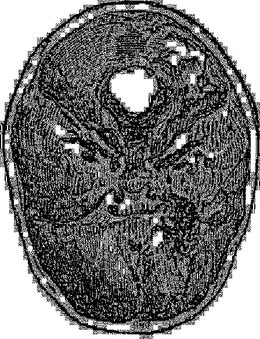
the story that grew Malcolm Macmillan collected the textbook versions of Gage and found that they grew with time: Gage the drunk, the brawler, the fairground exhibit, the drifter who never worked again. Little of it is in the sources. Harlow's own record ends with a man holding down a demanding job abroad for years, which suggests a good deal of recovery. Kotowicz argues that the case was made to serve the theory of frontal localisation that came after it. the skull, measured The skull has been reconstructed several times, with different results. Damasio and colleagues (1994) modelled the iron's path through a standard brain and placed the damage in both frontal lobes. Ratiu and colleagues (2004), working from CT scans of the skull itself, confined it to the left. Van Horn and colleagues (2012) estimated which long-range connections the iron would have cut, and argued that the loss of wiring mattered as much as the loss of grey matter. A case is a person and a story about the person. Gage is the clearest example in neuroscience of the second outgrowing the first. in the tour: the room called "The patients' room" has a placard called "The story that grew" ··· notes
Sources
see also
|
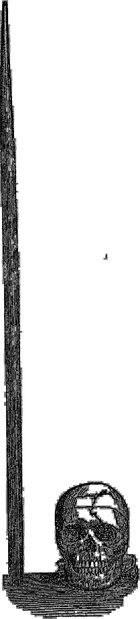
 t a railway cutting near Cavendish, Vermont, on 13 September 1848, a construction foreman named Phineas Gage was tamping blasting powder into a hole in rock when it went off. The tamping iron, three feet seven inches long and thirteen and a quarter pounds, went in under his left cheekbone and out through the top of his head. He was talking within minutes. His physician, John Martyn Harlow, kept him alive through infection, and twenty years later wrote up what had become of him (


 |
 |
 |
 |
 |
rev. Oct 24 2026