
|
Archive: Hodgkin & Huxley, the squid axon equations, 1952
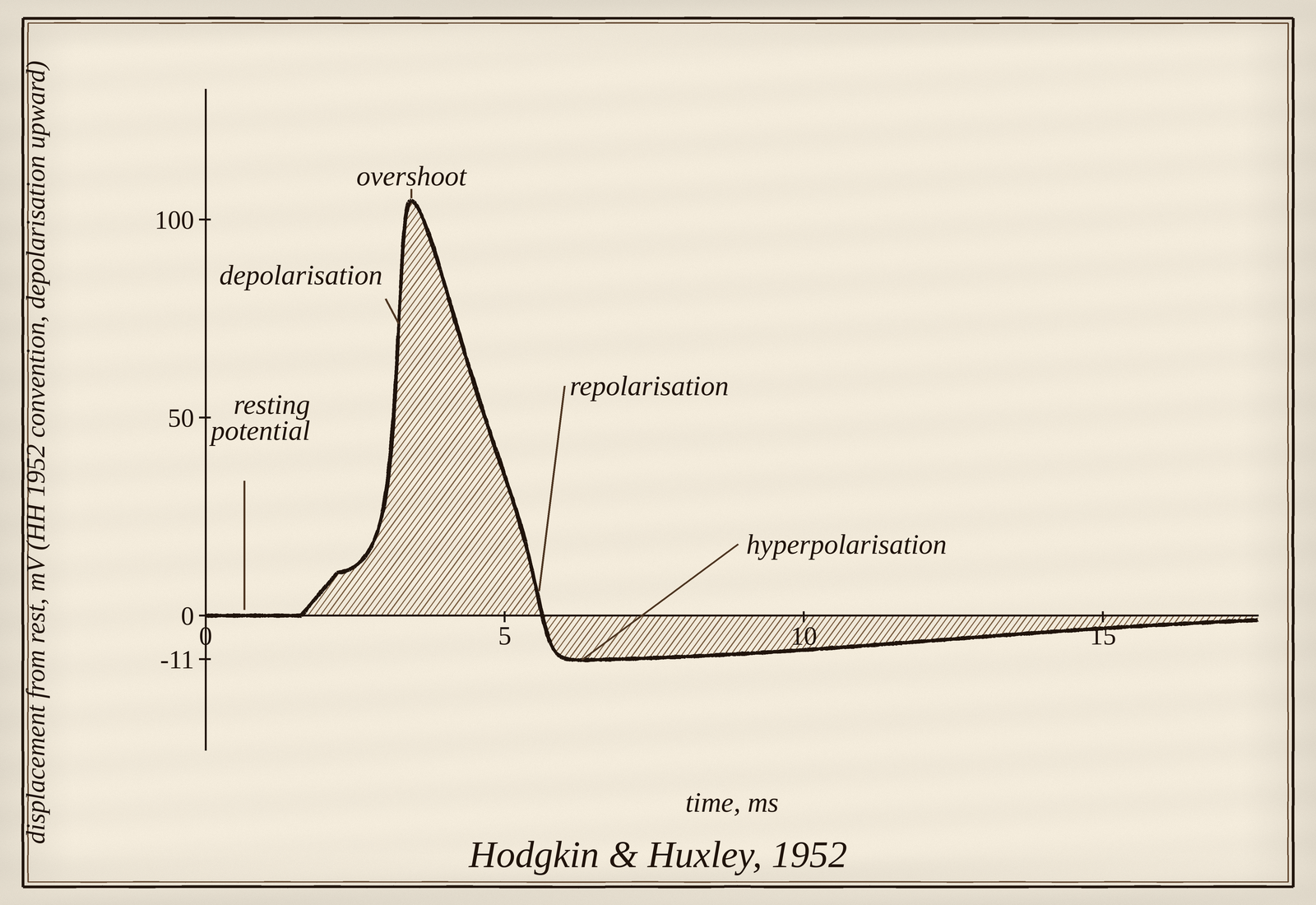
what it is, and where to read it A quantitative model of the membrane of the squid giant axon, a nerve fibre up to a millimetre across, wide enough to thread a wire along its length. The paper is on the publisher's page (DOI in the references); The Journal of Physiology makes its archive free to read. what it says The membrane is treated as an electrical circuit: a capacitor in parallel with separate pathways for sodium, potassium and a small leak. Each pathway's conductance depends on voltage and time through hypothetical "gating particles", fitted to measurements made with the voltage clamp. Solved numerically, by Huxley with a mechanical calculator, the equations produced a spike of the right shape, threshold, refractory period and, most strikingly, conduction speed, which had not been put into the fit.
what's contested Little about the result. The question was always what the gating particles were. Hodgkin and Huxley said plainly that their equations described rather than explained. Ion channels, single proteins opening and closing, were recorded directly only in the 1970s with the patch clamp, and they turned out to behave much as the fitted terms required. A model that worked too well, before anyone could say why, is a recurring pattern; see interpretability. methodological critiques The squid axon is unmyelinated and unusually large; vertebrate neurons have many more kinds of channel. The space clamp assumed a uniform membrane. Later work fitted far richer models to the same framework, and some critics note that a model with enough fitted terms can match a great deal. later reception Hodgkin, Huxley and Eccles shared the Nobel Prize in 1963. The equations are the ancestor of every conductance-based neuron model, and the contrast with the McCulloch–Pitts neuron, which keeps only the threshold, is the standing question of how much biology a model of thought needs. in the tour: the room called "The squid" has a placard called "Four equations" ··· References
see also
|
 n the last of five papers published in The Journal of Physiology in 1952, Alan Hodgkin and Andrew Huxley wrote down four equations for the nerve impulse and showed that they reproduced it (


 |
 |
 |
 |
 |
rev. Oct 24 2026