
|
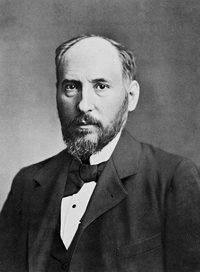
Santiago Ramón y Cajal
1852–1934 · histologist, Valencia, Barcelona, Madrid
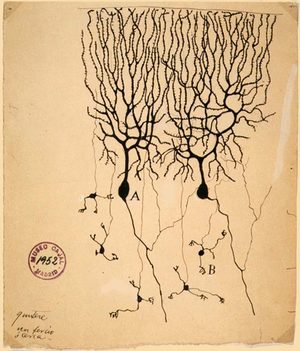
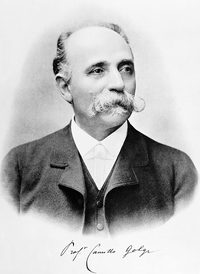
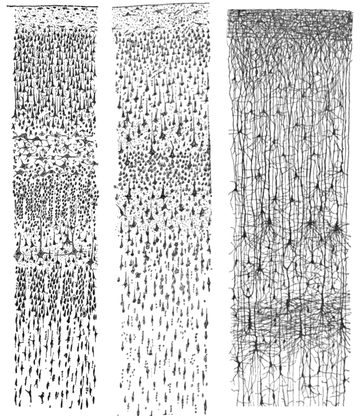
the stain In 1873 Camillo Golgi, in Italy, found that hardening nerve tissue and soaking it in silver nitrate turned a few cells, at random, completely black, every branch visible against a clear background: the reazione nera, the black reaction. From 1887 Cajal improved it and applied it to embryonic and young tissue, where the cells are smaller and the fibres not yet wrapped, and drew what he saw, thousands of times.
the argument Golgi held the reticular theory: fibres fuse into a continuous net. Cajal argued that every nerve cell is a separate unit whose branches end freely near other cells, and that signals pass one way, from dendrites and cell body to axon. This became the neuron doctrine. In 1906 the two men shared the Nobel Prize "in recognition of their work on the structure of the nervous system" (Nobel Prize Outreach, 1906), and Golgi used his lecture to restate the net.
Cajal was right about the general case; electron micrographs in the 1950s showed the gap. Golgi was not simply wrong: some cells are joined directly by electrical synapses (Furshpan & Potter, 1959), and the history of the dispute is less tidy than the textbook version (Bullock et al., 2005).
why he is here Every unit in an artificial network is a picture of Cajal's neuron with the shape taken out. The shape is now coming back: see connectomics. in the tour: the room called "The black reaction" has a placard called "Two men, one stain, one prize" ··· Primary works and sources
see also
|
 he son of a country doctor in Aragon, Santiago Ramón y Cajal wanted to be a painter and was made to study medicine. He served as an army doctor in Cuba, caught malaria and came home to an academic career in histology, in Valencia, Barcelona and from 1892 Madrid.


 |
 |
 |
 |
 |
rev. Oct 24 2026