
|
secrecy
The one-time pad has no such weakness. Add a truly random key, as long as the message, used once, letter by letter mod 26. Frank Miller described it in 1882 for telegraphs. Gilbert Vernam built it into teleprinter hardware, patented in 1919. [paraphrase, not a quotation] Shannon proved that a one-time pad gives perfect secrecy: seeing the ciphertext tells an attacker nothing about the message, because every plaintext of that length is equally likely. He also proved that anything with perfect secrecy needs a key at least as long as the message. (after C. E. Shannon, "Communication Theory of Secrecy Systems", Bell System Technical Journal 28(4), pp. 656–715, 1949) In Bayes terms: the posterior is the prior. You learn nothing. The pad is pure noise and that's the point. If you find a pad lying around on this site, it's meant to be used once. |
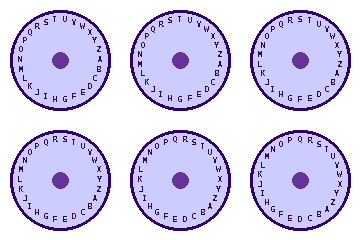 Enigma scrambled each letter through rotors that stepped every key press, so the same letter never came out the same twice running. Its weakness was probabilistic: a letter could never encrypt to itself, operators reused habits, messages started predictably. Each weakness shifts the odds a little. Marian Rejewski broke it first, late in 1932; Turing's bombe followed in 1939. See

 |
 |
 |
 |
 |
updated 10/24/26