
|
the integrator, and a bronze computer
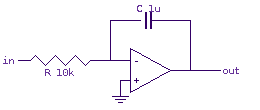
Put a capacitor in the feedback path of an op-amp and the output becomes the running total of the input, upside down. This is how analog computers did calculus: integrators wired together to solve differential equations in real time.
R = 10 kΩ, C = 1 µF, 1 V in: the output ramps at −100 V/s. ngspice (ideal op-amp, gain 106) gives -0.9999985 V after 10 ms. The script says −1.
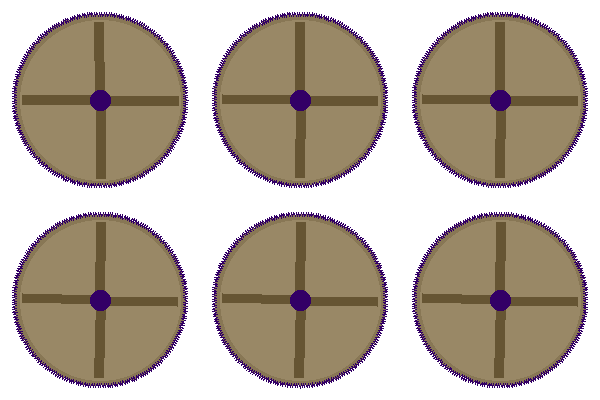
Its largest gear had 223 teeth, which is not a random number: 223 lunar months is the saros, the eclipse cycle. A gear is an integrator too, in its way. Turn the input, and the output keeps count. (gear drawing is a homage with 223 teeth, not a copy of the fragment)
|

 The other analog computer here is much older. The Antikythera mechanism was found in 1901 in a shipwreck off Antikythera, Greece. It's a hand-cranked box of bronze gears from the 2nd century BC that modelled the sky: positions of sun and moon, eclipses predicted years ahead, even the four-year cycle of the games. It is the oldest known analogue computer.

 |
 |
 |
 |
 |
Last updated: October 24, 2026