|
Fourier, 1822
 n 1822 Joseph Fourier published his Théorie analytique de la chaleur, a book about heat that happened to claim any reasonable function can be built out of sines and cosines. Mathematicians argued about how reasonable for the next century. Engineers just used it.
| f(t) = a0 + Σ [ an cos(nωt) + bn sin(nωt) ] |
There's a limit built into it. A signal can't be narrow in time and narrow in frequency at once. Gabor put it as Δt·Δf ≥ 1/(4π). The same math is behind Heisenberg's uncertainty, which is either deep or a coincidence of notation, depending who you ask.

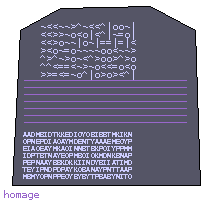 Fourier was prefect of Isère, based at Grenoble, and he encouraged a boy there named Jean-François Champollion. The Rosetta Stone, a granodiorite stele from 196 BC carrying a decree for Ptolemy V, repeats one text in three scripts: hieroglyphic, Demotic and Greek. On 27 September 1822, the same year as Fourier's book, Champollion announced his decipherment in the Lettre à M. Dacier.
Two kinds of decoding in one year from the same town.
(the stone is a homage drawing)
| 





