base 60 and base 20
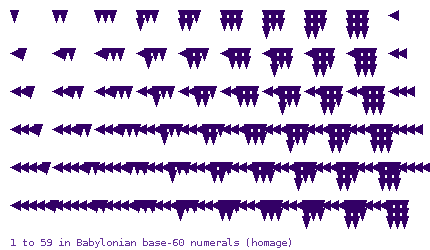
 he Sumerians counted in sixties by the 3rd millennium BC, and the Babylonians inherited it. It's why an hour has 60 minutes and a circle has 360 degrees. Sixty divides cleanly by 2, 3, 4, 5, 6, 10, 12, 20 and 30, which is handy if you're splitting grain.
 Plimpton 322 is a Babylonian clay tablet from around 1800 BC with a table of Pythagorean triples, about a thousand years before Pythagoras. Its first row, in our numbers, works out to a right triangle with sides 119 and 120 and hypotenuse 169. Check it: 119² + 120² = 14161 + 14400 = 28561 = 169².

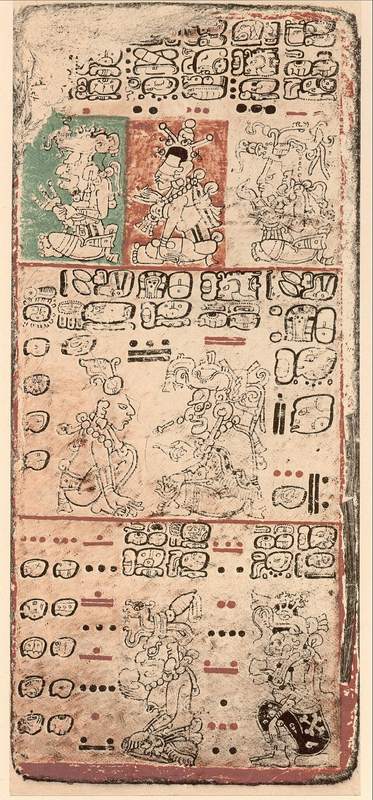
 The Maya counted in twenties, with a shell for zero. The Long Count calendar is base 20 with one base-18 place, counting days from a creation date that works out to August 11, 3114 BCE in our calendar (under the usual correlation). The Dresden Codex, pictured, is full of these numbers, including eclipse tables. (1880 facsimile via FAMSI, public domain)